FlemingClans.com

"The Fleming Clan of Scotland: a genealogical history" - coming in late 2026!
Person Page 273
Sir Malcolm ("the Unfortunate") Fleming, of Cumbernauld
b. circa 1372, d. 28 November 1440
Person Exhibits
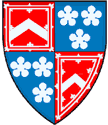
Arms of the Fleming Earls of Wigtown
Birth
Sir Malcolm ("the Unfortunate") Fleming, of Cumbernauld, was born circa 1372.
Parents
| Father | Sir David ("the Trustworthy") Fleming, of Biggar, Lenzie and Cumbernauld (b. circa 1328, d. 14 February 1406) |
| Mother | Isobel de Strathechin, heiress of Monycabock (b. circa 1340) |
Family life
Sir Malcolm ("the Unfortunate") Fleming, of Cumbernauld, and Lady Elizabeth Stewart were married circa 1400. Before 28 Jun 1413.1,2
Children with Lady Elizabeth Stewart (b. circa 1384, d. circa 1446)
| Son | Malcolm Fleming, of Biggar (b. circa 1393, d. before 20 November 1440) |
| Son | Sir Robert ("the Rebel") Fleming, of Cumbernauld, 1st Lord Fleming+ (b. circa 1400, d. 1491) |
| Daughter | Lady Marion ("Margaret") Fleming (b. circa 1409) |
Child
| Son | John Fleming (b. circa 1400) |
Property3,4
Sir Malcolm ("the Unfortunate") Fleming, of Cumbernauld, possessed had a charter, as son and heir of David Fleming of Biggar, Knight, to him, and his heirs-male of his body, whom failing, to David, his brother, from King Robert in. of the castle and lands of Cumbernauld and others, reserving his liferent on 7 March 1401 in Cumbernauld.5,6,7 He possessed had a charter from King Robert III of the lands of Barbreck, in the earldom of Carrick on 24 August 1404 at Earldom of Carrick in Barbeck.5,8 He possessed had a charter from Robert III of the barony of Cavers in Roxburghshire on 10 August 1405 at Roxburghshire in Cavers.8 He possessed had a charter from Robert III of Cumbernauld on 2 April 1406 in Cumbernauld and pertinents.8,9 He possessed mortgaged Oliver Castle to Robert Dickson for 100 pounds circa 1413 in Oliver Castle.10,11,12 He possessed had a charter from his said father-in-law the Duke of Albany of the lands of Torwood, in Stirlingshire, which had been resigned by William Lindsay of Byres on 8 June 1413 in Torwood in Stirlingshire.5,13,14,7,9 He possessed had a charter from Robert, Duke of Albany, of the lands and barony of Biggar, and annualrents upliftable from the lands of Kerse pertaining to the Abbey of Holyroodhouse on 28 June 1413 at Barony in Biggar.5,15,16,2,17 5,18,195,20 He possessed was beneficiary of a charter of resignation of Gartangaber by Agnes Paa and Edana Logan in 1439 at Lenzie in Gartangaber.21,225,23
5,18,195,20 He possessed was beneficiary of a charter of resignation of Gartangaber by Agnes Paa and Edana Logan in 1439 at Lenzie in Gartangaber.21,225,23 Death
Sir Malcolm ("the Unfortunate") Fleming, of Cumbernauld, died executed for treason (trumped up) on 28 November 1440 at age ~68 in Castle Hill, Edinburgh. Accompanying William, Earl of Douglas, to the Castle of Edinburgh, he was, after a mock trial, along with the Earl and his brother, found guilty of treason, beheaded there 24 November 1440, and his lands of Monycabok forfeited - Balfour Paul.
In 1440 on 24 November William earl of Douglas and his brother David were arrested along with Malcolm Fleming lord of Cumbernauld at Edinburgh castle, and beheaded on the castle hill - Scotichchronicon. DEB Watt commenst - The date here was the day when the Douglases were executed, Fleming was executed three days later.
But the house of Douglas had not ceased to be a source of apprehension to Livingston and Crichton. Earl AVilliam was but a boy of sixteen when he succeeded, but they soon foresaw in him a dangerous enemy. Imperious, extravagant, and ambitious, he is admitted even by Hume of Godscroft to have refused to acknowledge the authority of government, and to have acted with more than kingly power. AVe know not how far his acts may have technically rendered him amenable to the treason laws, or in what ways he made himself obnoxious to the governing party. On the 24th November 1440, the young Earl and his only brother, with their friend and confidant, Malcolm Fleming, a man in advanced years, the brother-in-law of the Eegent Murdach — and who is said to have been sent as ambassador by Douglas to the French Court to convey his homage for the duchy of Touraine — were arrested within Edinburgh Castle on a charge of treason. The Earl and his brother, after a hasty trial, were convicted and beheaded, and three or four days later the same fate overtook Fleming. - RSRS, v, lv.
At such time as he came to the castell, the gouernor (according to his promise) was readie there to meet him, to the end the matter might seeme to be wrought by common consent, and the weight of so great enuie might not light vpon the head of one man. Dowglasse being honorablie and friendlie by the gouernor receiued into the castell, was for dinner placed at the kings table. But in the middest of this sweet meat (sower sawce being prepared) there was a bulles head set before him, which in those dales was a signe of death. Wherewith the yoong man amazed (and greatlie troubled in his mind, inwardlie repenting that he followed not the aduise of his followers) was about to rise from the table : but being apprehended by armed men (appointed to that function) he was caried into the court next to the castell, and was there (in reuenge and punis|iment of his vnbrideled youth) beheaded, with his brother Dauid, and Malcolme Fleming, who (next vnto his brother) was in greatest credit with him. Whose death the king now entring V into his adolescencie or yeers (as we tearme it) of discretion, is said heauilie with teares to lament, which the chancellor (grieuing to see) did greatlie rebuke in the king such vntimelie and inordinate mourning, for the death of his and the common-wealths enimie, whose Hfe (said hee) would haue taken awaie all peace and tranquillide in the realme. - Holinshed, v, 432
Pinkerton - By plaufible invitations, and flatteries, William earl of Douglas, his brother David, and Malcom Fleming of Cumbernauld, a faithful* adherent of the family, were inveigled into the caftle of Edinburgh, and after an infldious entertainment, and a brief and delulbry trial, were beheaded ^ The earldom of Douglas fell to the next male heir, James lord of Abercorn, llirnamed the Groff, a prudeijt and peaceable ma^n, but who unfortunately •enjoyed his title only two years, and deft a turbulent William, the third of that name
Hunter -
It has been generally asserted, that the trial and execution of Sir Malcolm Fleming took place at the same time with the Douglasses. This is a mistake. It has been ascertained that he was not tried and executed till the fourth day after his friends had been deprived of life. After a form of trial, as illegal as it was insulting, he was brought to the Castlehill, the usual place of execution at the time, and there his head was struck from his body by the axe of the headsman ; thus ignominiously losing his life for no other crime that history has left on record than that he was a friend to the youthful Douglas, and obnoxious to men inflamed with mad ambition, and ready to make a cruel and unwarrantable use of the power that had fallen into their hands.4,5,24,25,26,27,2,28,29,30
In 1440 on 24 November William earl of Douglas and his brother David were arrested along with Malcolm Fleming lord of Cumbernauld at Edinburgh castle, and beheaded on the castle hill - Scotichchronicon. DEB Watt commenst - The date here was the day when the Douglases were executed, Fleming was executed three days later.
But the house of Douglas had not ceased to be a source of apprehension to Livingston and Crichton. Earl AVilliam was but a boy of sixteen when he succeeded, but they soon foresaw in him a dangerous enemy. Imperious, extravagant, and ambitious, he is admitted even by Hume of Godscroft to have refused to acknowledge the authority of government, and to have acted with more than kingly power. AVe know not how far his acts may have technically rendered him amenable to the treason laws, or in what ways he made himself obnoxious to the governing party. On the 24th November 1440, the young Earl and his only brother, with their friend and confidant, Malcolm Fleming, a man in advanced years, the brother-in-law of the Eegent Murdach — and who is said to have been sent as ambassador by Douglas to the French Court to convey his homage for the duchy of Touraine — were arrested within Edinburgh Castle on a charge of treason. The Earl and his brother, after a hasty trial, were convicted and beheaded, and three or four days later the same fate overtook Fleming. - RSRS, v, lv.
At such time as he came to the castell, the gouernor (according to his promise) was readie there to meet him, to the end the matter might seeme to be wrought by common consent, and the weight of so great enuie might not light vpon the head of one man. Dowglasse being honorablie and friendlie by the gouernor receiued into the castell, was for dinner placed at the kings table. But in the middest of this sweet meat (sower sawce being prepared) there was a bulles head set before him, which in those dales was a signe of death. Wherewith the yoong man amazed (and greatlie troubled in his mind, inwardlie repenting that he followed not the aduise of his followers) was about to rise from the table : but being apprehended by armed men (appointed to that function) he was caried into the court next to the castell, and was there (in reuenge and punis|iment of his vnbrideled youth) beheaded, with his brother Dauid, and Malcolme Fleming, who (next vnto his brother) was in greatest credit with him. Whose death the king now entring V into his adolescencie or yeers (as we tearme it) of discretion, is said heauilie with teares to lament, which the chancellor (grieuing to see) did greatlie rebuke in the king such vntimelie and inordinate mourning, for the death of his and the common-wealths enimie, whose Hfe (said hee) would haue taken awaie all peace and tranquillide in the realme. - Holinshed, v, 432
Pinkerton - By plaufible invitations, and flatteries, William earl of Douglas, his brother David, and Malcom Fleming of Cumbernauld, a faithful* adherent of the family, were inveigled into the caftle of Edinburgh, and after an infldious entertainment, and a brief and delulbry trial, were beheaded ^ The earldom of Douglas fell to the next male heir, James lord of Abercorn, llirnamed the Groff, a prudeijt and peaceable ma^n, but who unfortunately •enjoyed his title only two years, and deft a turbulent William, the third of that name
Hunter -
It has been generally asserted, that the trial and execution of Sir Malcolm Fleming took place at the same time with the Douglasses. This is a mistake. It has been ascertained that he was not tried and executed till the fourth day after his friends had been deprived of life. After a form of trial, as illegal as it was insulting, he was brought to the Castlehill, the usual place of execution at the time, and there his head was struck from his body by the axe of the headsman ; thus ignominiously losing his life for no other crime that history has left on record than that he was a friend to the youthful Douglas, and obnoxious to men inflamed with mad ambition, and ready to make a cruel and unwarrantable use of the power that had fallen into their hands.4,5,24,25,26,27,2,28,29,30
Citations
- [S44] Scotland Court of Exchequer, Rotuli scaccarii regum Scotorum, vol 4, p clxxxviii

- [S83] George Vere Irving, The upper ward of Lanarkshire described and delineated, vol i, p 311
- [S5] William Hunter, Biggar and the House of Fleming, p 480
- [S21] George Crawford, The Peerage of Scotland, p 491-499, Fleming, Earl of Wigtown
- [S28] Sir James Balfour Paul, The Scots Peerage, vol viii, Fleming Earl of Wigtown pages 519 - 558
- [S17] Francis J Grant (Ed), Charter Chest of the Earldom of Wigtown, Charters 15 & 16
- [S5] William Hunter, Biggar and the House of Fleming, p 483
- [S5] William Hunter, Biggar and the House of Fleming, p 484
- [S132] Thomas Watson, Kirkintilloch, p 15
- [S43] Scotland Court of Exchequer, Registrum Magni Sigilli Regum Scotorum, vol i, 1306-1424, app 2, ch 1970
- [S24] William Robertson, An Index of many Records of Charters granted by different Sovereigns of Scotland, p 159, ch 4, Abercone, Oliver castle
- [S64] Cosmos Nelson Innes, Origines Parochiales Scotiae, vol i, p 206
- [S43] Scotland Court of Exchequer, Registrum Magni Sigilli Regum Scotorum, vol i, 1306-1424, app 2, ch 1969
- [S24] William Robertson, An Index of many Records of Charters granted by different Sovereigns of Scotland, p 159, ch 2, Abercone, Torwood
- [S43] Scotland Court of Exchequer, Registrum Magni Sigilli Regum Scotorum, vol i, 1306-1424, app 2, ch 1971
- [S80] William Fraser, The Red Book of Menteith, vol ii, p 436
- [S24] William Robertson, An Index of many Records of Charters granted by different Sovereigns of Scotland, p 159, ch 3, Abercone, barony of Biggar
- [S17] Francis J Grant (Ed), Charter Chest of the Earldom of Wigtown, Charter 248
- [S58] Edinburgh, National Records of Scotland, "Online Catalogue," National Records of Scotland (https://catalogue.nrscotland.gov.uk/nrsonlinecatalogue: accessed ), ., viewed; 19 September 2025; RH1/2/185 and RH1/2/186, 3 Nov 1421, James Flemyng, son of umquhile Patrick Flemyng in favour of Malcolm Flemyng, Lord of Bygate, of Ovirmynyane and Glenruscow in the Sheriffdom of Peebles; and Le Borde in the Sheriffdom of Donbretan
- [S58] Edinburgh, National Records of Scotland, "Online Catalogue," National Records of Scotland (https://catalogue.nrscotland.gov.uk/nrsonlinecatalogue: accessed ), ., viewed; 19 September 2025; RH1/2/193 and RH1/2/194, 30 Jan 1425/1426, James Flemyne, son of umquhile Patrik Flemyne of Bord, in favour of David Fleming, son of umquhile Sir David Fleming, Lord of Bigare
- [S17] Francis J Grant (Ed), Charter Chest of the Earldom of Wigtown, Charter 22
- [S58] Edinburgh, National Records of Scotland, "Online Catalogue," National Records of Scotland (https://catalogue.nrscotland.gov.uk/nrsonlinecatalogue: accessed ), ., viewed; 19 September 2025; RH1/2/216, 26 Jun 1439, Agnes Raa and Edana Logane, her grand-daughter, in favour of Malcolm Flemyng, Lord of Biggar, of Gartyngabyr in the Sheriffdom of Dunbartane
- [S58] Edinburgh, National Records of Scotland, "Online Catalogue," National Records of Scotland (https://catalogue.nrscotland.gov.uk/nrsonlinecatalogue: accessed ), ., viewed; 19 September 2025; GD45/27/143, 7 Feb 1439/1440, Transcript of bond by Malcolm Fleming, lord of Bygar, to Andrew Gray, lord of Foulys, for payment of tocher for the marriage of the daughter of the said Malcolm and the son of the said Andrew
- [S44] Scotland Court of Exchequer, Rotuli scaccarii regum Scotorum, vol 5, p lv
- [S53] Walter Bower, Scotichchricon, vol ix, ch 9, line 42, p 141
- [S51] Raphael Holinshed, Holinshed's Chronicle, Scotland, vol v, p 697, https://archive.org/details/chroniclesofengl05holiuoft/page/697/mode/2up
- [S51] Raphael Holinshed, Holinshed's Chronicle, Scotland, vol v, p 432, https://archive.org/details/chroniclesofengl05holiuoft/page/432/mode/2up
- [S84] John Pinkerton, The History of Scotland, vol i, p 194
- [S84] John Pinkerton, The History of Scotland, vol i, p 502
- [S5] William Hunter, Biggar and the House of Fleming, p 488
| Context | Ch forebears (#1) Ch forebears (#2) Ch forebears (#3) Ch forebears (#4) Ch forebears (#5) Ch forebears (#6) |
| Last Edited | 19 September 2025 |