FlemingClans.com

"The Fleming Clan of Scotland: a genealogical history" - coming in late 2026!
Person Page 335
Sir John ("the Defiant") Fleming, 5th Lord Fleming
b. circa 1528, d. 6 September 1572
Person Exhibits
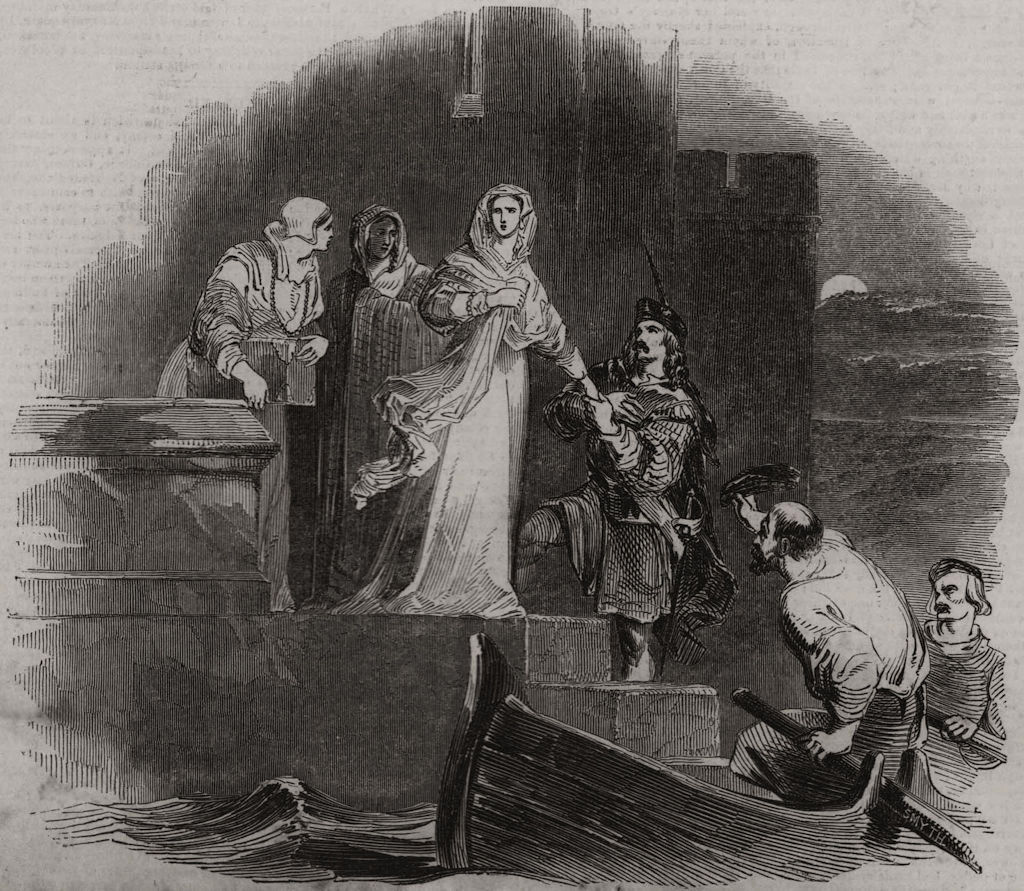
MQOS escapes LochLeven

Birth
Sir John ("the Defiant") Fleming, 5th Lord Fleming, was born circa 1528.
1
1
Parents
| Father | Sir Malcolm ("the Brave") Fleming, 3rd Lord Fleming (b. 14 January 1494, d. 10 September 1547) |
| Mother | Janet ("la Belle Écossaise") Stewart, Lady Fleming (b. 17 July 1502, d. 20 February 1562) |
Family life
Sir John ("the Defiant") Fleming, 5th Lord Fleming, and Elizabeth Ross, sole heiress of Ross, were married on 10 May 1562. The contract for this marriage is dated 22 February 1561-62. Mary, Queen of Scots paid for the wedding banquet and a gown of silk taffeta with gold trimmings for the bride. The celebrations were held in Holyrood Park at the side of the loch and there were "great triumphs", shows and masques involving a staged sea-battle or naumachia said by Robert Lindsay of Pitscottie to represent the "figure" of the siege of Leith. The Earl of Wismar ambassador from Sweden attended.
The Queen gave a devant of cloth of gold etc for her wedding dress.
Robertson -
They held their marriage feast in the open air : ' The bankett was made in the Parke of Holyroudhous, imder Arthur's Seatt, at the end of the loche, quher grate triumph wes made, the Quein's Grace being present, and the King of Suethland's embassador, with many other nobles.* — (G. Marioreybanks, Annals of Scotland, p. 14. Diurnal of Occurrents, p. 72.)
As Robert Chambers says, " The incident is so pleasantly picturesque, and associates Mary so agreeably with one of her subjects, that it is gratifying to reflect on Lord Fleming proving a steady friend throughout her subsequent troubles."
Watson - The marriage took place in the presence of Queen Mary and her court at Holyrood.
Royal palaces of Scotland by Douglas-Irvine, Helen; Rait, Robert S. (Robert Sangster), 1874-1936, p79 -
https://archive.org/details/royalpalacesofsc00douguoft/page/78/mode/2up?q=fleming
The ambassador of Sweden was honourably received by Mary at Holyrood House on the 2Oth of May. The day was that of the marriage of Lord Fleming ; and the queen and court, with their guest, witnessed a representation of the siege of Leith on Duddingston Loch, for which a castle and galleys had been constructed of timber, and which was rendered realistic by the shooting of great guns. The ambassador left at the end of the month, and the queen gave him at parting a chain valued at a thousand crowns.2,3,4,5
The Queen gave a devant of cloth of gold etc for her wedding dress.
Robertson -
They held their marriage feast in the open air : ' The bankett was made in the Parke of Holyroudhous, imder Arthur's Seatt, at the end of the loche, quher grate triumph wes made, the Quein's Grace being present, and the King of Suethland's embassador, with many other nobles.* — (G. Marioreybanks, Annals of Scotland, p. 14. Diurnal of Occurrents, p. 72.)
As Robert Chambers says, " The incident is so pleasantly picturesque, and associates Mary so agreeably with one of her subjects, that it is gratifying to reflect on Lord Fleming proving a steady friend throughout her subsequent troubles."
Watson - The marriage took place in the presence of Queen Mary and her court at Holyrood.
Royal palaces of Scotland by Douglas-Irvine, Helen; Rait, Robert S. (Robert Sangster), 1874-1936, p79 -
https://archive.org/details/royalpalacesofsc00douguoft/page/78/mode/2up?q=fleming
The ambassador of Sweden was honourably received by Mary at Holyrood House on the 2Oth of May. The day was that of the marriage of Lord Fleming ; and the queen and court, with their guest, witnessed a representation of the siege of Leith on Duddingston Loch, for which a castle and galleys had been constructed of timber, and which was rendered realistic by the shooting of great guns. The ambassador left at the end of the month, and the queen gave him at parting a chain valued at a thousand crowns.2,3,4,5
Children with Elizabeth Ross, sole heiress of Ross, (b. circa 1542, d. after 14 April 1578)
| Daughter | Mary Fleming (b. circa 1562) |
| Daughter | Jean Fleming+ (b. circa 1565, d. October 1630) |
| Daughter | Margaret Fleming (b. circa 1566) |
| Son | John ("the Arbitrator") Fleming, 1st Earl of Wigtown and 6th Lord Fleming+ (b. 1567, d. after 12 August 1619) |
| Daughter | Elizabeth Fleming (b. circa 1568) |
Child with Nicolas Somerville (b. circa 1550)
| Daughter | Lucrece Fleming (b. circa 1572, d. after 4 August 1593) |
Residence information
Sir John ("the Defiant") Fleming, 5th Lord Fleming, in Dunbarton Castle after October 1568. Lord Fleming, after this period, took up his abode in Dumbarton Castle, of which he still continued to be Governor. The Master of Graham was several times sent to the Castle for the purpose of persuading him to surrender it to the Kegent ; but he obstinately persisted in rejecting all overtures on the subject. The Kegent, therefore, invested it with a considerable force, and as any attempt to carry it by assault was considered hopeless, the siege was turned into a blockade6 He took up residence in Edinburgh Castle in Edinburgh Castle on 26 June 1572. On the 26th day of June, he arrived in Edinburgh at the head of a detachment of thirty horsemen, and took up his residence in the Castle, then held for the Queen by the stout warrior Sir William Kirkaldy of Grange7
Titles
Working life
- In 1565 Sir John ("the Defiant") Fleming, 5th Lord Fleming, was occupied as Governor in Dumbarton Castle.2,8,9
- On 15 February 1565 Sir John ("the Defiant") Fleming, 5th Lord Fleming, was occupied as Justiciary within the bounds of his lands in Peebles, Lanark, Stirling, Dunbarton, and Forfar in Edinburgh. This appointment applied within the bounds of his lands in Peebles, Lanark, Stirling, Dunbarton, and Forfar so that he could bring to justice any perpetrators of theft and larceny and other capital crimes.10
- On 30 June 1565 Sir John ("the Defiant") Fleming, 5th Lord Fleming, was occupied as Great Chamberlain for life.2,11,12,9,13
- On 17 July 1565 Sir John ("the Defiant") Fleming, 5th Lord Fleming, was occupied as Privy Councillor.
- On 25 July 1565 Sir John ("the Defiant") Fleming, 5th Lord Fleming, was occupied as Master Usher of Her Majesty's Chambers during his life.2,8,10,4
- On 1 August 1565 Sir John ("the Defiant") Fleming, 5th Lord Fleming, was occupied as Chamberlain and Master Usher.14
- He served in the military as was appointed to accompany the king in leading the forthcoming battle on 10 October 1565.15
- On 25 March 1566 Sir John ("the Defiant") Fleming, 5th Lord Fleming, was occupied as Secret Council in Edinburgh.16
- On 1 August 1566 Sir John ("the Defiant") Fleming, 5th Lord Fleming, was occupied as Lord Chamberlain. This must have been an official confirmation of the appointment first made a year earlier4
- He witnessed the occupation of Margaret Carwood, confidante of Mary Queen of Scots, after 10 February 1567 as a left the queen's service.17
- On 28 March 1567 Sir John ("the Defiant") Fleming, 5th Lord Fleming, was occupied as justiciary in Peeblesshire. Lanarkshire - 1567 obtained the office of justiciary, within the bounds of the Overward of Clydesdale and Peeblesshire18,12
- On 28 March 1567 Sir John ("the Defiant") Fleming, 5th Lord Fleming, was occupied as Governor in Dumbarton Castle. Lanarkshire - being at the same time made governor of Dumbarton 12,4
- On 28 March 1567 Sir John ("the Defiant") Fleming, 5th Lord Fleming, was occupied as overwarden in Clydesdale.18,12
- On 28 March 1567 Sir John ("the Defiant") Fleming, 5th Lord Fleming, was occupied as Justiciary within the sheriffdom of Peebles and Overward of Lanarkshire. Eighth commission made to John, lord Fleming, to justify all thieves, robbers, and malefactors, and murderers, according to the laws of the kingdom, within the bonds of the sheriffdom of Peebles and the superior ward of Clydesdale, etc., to receive for his own use one-half of the eschats of all such persons convicted of the aforesaid crimes, and to import and apply another half of the same to the queen's use, etc., at the queen's pleasure, until she has exonerated the same.2,19,12,4
- He served in the military as was present at the standoff when MQOS sent Boswell to Dunbar and then surrendered on favourable terms on 15 June 1567 in Carberry Hill. Lanarkshire - His sister was one of the Queen's CEunous Maries, while he proved himself one of her most devoted adherents, and was a party to the association on her behalf, formed in 1568, in consequence of which he was, in the following year, forfeited by the dominant party 2,8,12,20,21
- He served in the military as took refuge in Dumbarton Castle along with the Queen's lords where they drew up the Dumbarton Bond on 1 August 1567 in Dumbarton Castle. Hunter -
In the Castle of Dumbarton, held for the Queen by Lord Fleming, they entered into a bond for the purpose of restoring the Queen to liberty. The document to which they appended their names commences by stating that they had no freedom of access to her Majesty for transacting their lawful business ; and therefore they bind themselves to use all diligence, and to adopt all reasonable means to set her at liberty, upon such conditions as may be consistent with her honour, the advantage of her kingdom, and the security of her subjects. In the event of the refusal of the noblemen who had her in custody to open her prison-doors, they declared that they would employ themselves, their kin and friends, their servants and partakers, and their bodies and lives, to put her Highness at liberty, as well as to procure the punishment of the murderer of the King her husband, and the safe preservation of the Prince her son. They also issued a proclamation from the same place, calling upon all good subjects to be ready on nine hours' warning to take arms for the delivery of the Queen.
* " The terms of the Dumbarton bond are : — Forasmuch, considering the Queen's Majesty, our Sovereign, to be unlawfully detained at pre- sent in Lochleven in captivity, wherefore the most part of her lieges cannot have free access to her Highness : and seeing that it becomes us of our duty to seek her liberty and freedom, we, earls, lords, and barons under subscribed, promise faith- fully to use the utmost of our endeavours, by all reasonable means, to procure her Majesty's liberty and freedom upon such honest conditions as may assent with her Majesty's honour, the common weal of the whole realm, and security of the whole nobility who at present have her Majesty in keep- ing; whereby this our native realm may be governed, ruled, and guided by her Majesty and her nobility, for the common quietness and admin- istration of justice in and weal of the country. And case the noblemen who have her Majesty at present in their hands refuse to set her at liberty upon such reasonable conditions as said is, in that case we shall employ ourselves, our kindred, friends, servants, and partakers, our bodies and our lives, to set her Highness at liberty, and also to concur to the punishment of the murderers of the King her Majesty's husband ; and for sure pre- servation of the person of the Prince, as we shall answer to God, and our honour, and credit ; and to that effect shall concur every one with another that are deemed proper. And if any shall set upon us, or any of us, for the doing as first mentioned, in that case we promise faithfully to espouse one another's interest under pain of perjury and in- famy, as we " In shall answer to God. witness whereof, we have subscribed these presents with our hands at Dumbarton, the " St. Andrews, Argyle, Huntly, Arbroath, Galloway, Ross, day of Fleming, Herries, Stirling, Kilwinning, Will Hamilton, of Sanquar.
Lanarkshire - Begardless of this, he, with unflinching loyalty, held for the Queen the strong fortress of Dumbarton, the possession of which became an object of great importance to Murray and his party. From this period trill his death, we find frequent mention of him in that most interesting contemporary record, the "Memorials of Richard IBannatyne/' Indeed, it would scarcely be possible to select from it a series of passages which could more clearly show, in so sliort a space, the bigoted ferocity and despicable meanness of tbis disciple and secretary of John Knox, than those relative to Ijord Fleming. In the earliest of these, which occurs in 1569, •we find the author unblushingly recording how he played the spy on his master and his friends; for he tells us that, on one occasion, when the Regent, Lord Lindsay, the Laird of Pittarrow, Mr John Wood, Mr James MacGill, the tutor of Pittarie, and Knox, came for consultation to the prime chamber of the last, *' I was sleeping in a bed within the cabinet, so that no man coidd see ma I was awakened by the bruite they made at their entry, and I might easily hear every word they spoke." Among other particulars of the conversation thus dishonourably overheard, he relates that the Laird of Pittarrow said — ^"To get Dumbarton I wold nocht stick for gear; and albeit I should give as meikle as Sir James Balfour gat Ane king seekand treasure may find land. An ye list ye may aye get your hand beyond my Lord Fleming." In this, however, he was mistaken ; as neither Lord Fleming nor his subordinates proved accessible to pecuniary bribery (Bann. Mem., p. 9).22,23 - He served in the military as was present at the battle on the Queen's side on 13 May 1568 in Langside. Managing to raise an army of 6,000 men, she met Moray's smaller forces at the Battle of Langside on 13 May.[148] Defeated, she fled south.
En route to Dumbarton, she was confronted at Langside by Moray, as regent for King James. Despite Mary’s superior forces, she was heavily defeated
The Earl of Murray had assembled a force of 4000 men at Glasgow, and a request was sent to him by the lords at Hamilton to agree to repone the Queen to her former status at the head of the government ; but as he refused to do this, it was resolved to conduct the Queen in a sort of warlike procession to the Castle of Dumbarton, on the 13th of May, under the direction of the Duke of Argyle, who had been appointed Commander-in-chief of the Queen's forces. The Earl of Murray no sooner learned that the Queen's army was on its march towards Dumbarton, than he crossed the Clyde, and took possession of the little village of Langside, where an obstinate engagement took place and the Queen's army was totally defeated.
French -
The battle continued for a quarter of an hour; at last, those of the Queen's party were broken and forced to march. The Earl of Murray begged those in his company to refrain from bloodshed, otherwise all the foot soldiers, being greater in number than the mounted ones, would have been completely defeated. The Queen's mounted soldiers, of whom Lord Heirs was general, fled.
The Queen, being on a mountain, saw this defeat, nearly half a mile from where she was; she, accompanied by Lord Boyde, Lord Flaming, and twenty people, took to flight, and were closely pursued.
The number of those killed is estimated at six to seven score people, not including those who have died since the battle.2,8,24,25 - He served in the military as refused a direction of the Regent and Privy Council to deliver Dunbarton Castle to the Regent and so Alexander Glencairn and Robert Semple were commissioned to capture it on 19 May 1568 in Dunbarton Castle.26
- 27
- He served in the military as was one of many lords ordered by the Privy Council to surrender a fortalice, in his case Cumbernauld on 24 May 1568 in Cumbernauld.27
- He served in the military as became one of the leaders of the Queen's forces in the Marian Civil War in June 1568. The Marian civil war in Scotland (1568–1573) was a period of conflict which followed the abdication of Mary, Queen of Scots, and her escape from Lochleven Castle in May 1568. Those who ruled in the name of her infant son James VI fought against the supporters of the Queen, who was exiled in England. Edinburgh Castle, which was garrisoned in her name, became the focus of the conflict and surrendered only after an English intervention in May 1573. The conflict in 1570 was called an "internecine war in the bowels of this commonwealth",[1] and the period was called soon after an "internecine war driven by questions against authority."[2]28
- In June 1568 Sir John ("the Defiant") Fleming, 5th Lord Fleming, was occupied as Ambassador for the queen in London. Lord John Fleming, after returning from London, was despatched by Queen Mary to the French court, to explain the late events in her history, to vindicate her character, and ask for advice and assistance
THIS IS NOT RIGHT. hE DIDNT GET A PASSPORT FOR FRSNCE.
French ambassador to French king -
Sire, about eight days ago there were two Scottish lords sent here on behalf of the said Lady, namely Lord Herrys, to this Queen to ask her, according to the promises she made to him a long time ago, to give her help against her rebels, or, in case she cannot or will not give her the said help, to allow her to pass into France by that country. The other is Mr. de Flemmyng, the one who holds Dumbertran, who has asked for a passport to go to Your Majesty, according to the charge he had from his mistress. They were heard two or three times and remitted to have a reply from one time to the other, having not been able to have a resolution until last Thursday;29,30 - He served in the military as organised the defence of Dumbarton for the queen in September 1568 in Dumbarton. The queen returned as a widow to Scotland thirteen years later. Her next visit to Dumbarton was not until 1563, when she stayed merely to dine on 15July, while progressing through the Lennox and Argyll. 155 In May 1568, after her disastrous defeat at the battle of Langside, she was probably aiming for the safety of Dumbarton Castle, held by her supporters, 156 with the possibility of flight to France, when the forces of the regent, James Stewart, earl of Moray, barred the way and she turned south. 157 After her enforced flight to England, the castle and the nearby town were still to remain central pivots in Scottish politics. The castle was held by the queen's party for the first three years of the civil war which followed.John, fifth Lord Fleming, governor of the castle and a staunch queen's man, took further measures to ensure his position. In September 1568, with the help of Archibald, fifth earl of Argyll, he hired between eighty and a hundred hagbutters and had them fortify Dumbarton church. It was said at the time that the whole town was 'as a fortress'.158 In the same month, the town witnessed the collection of the signatures of seven earls, twelve lords, eight bishops and nine commendators for a document ('The Dumbarton Bond') pledging their support to the exiled queen. 159 By 1569, however, pressure was increasing on the Marian garrison and proclamations were made at the town's market cross in an attempt to rally support for its relief by the king's party. The men of Glasgow, Ayr and Irvine were also instructed to convene at Dumbarton, and in August of the same year, legislation was passed imposing a levy which would support the maintenance of a permanent siege of the castle 'alsweil be sey as land'.1
Correspondence from the regent to the burgesses of Dumbarton in December 1569 and January 15 70 suggests that the town had expended considerable sums of money in the support of the regent's men, by the supply of meat, drink and other necessities in the previous year.161 The town was to suffer further. As at Edinburgh, the townspeople found themselves caught between a royal castle held on behalf of the absent Queen and besieged by a force of king's men, with damage inflicted on the town by both sides. Lord Fleming demolished much of both the parish church and college church, although the latter had already been largely 'cassin doun be ye congregatioun in ye fiftie nyne zeir', during the Reformation crisis, 162 as well as the parish church of Cardross, along with the houses of many burgesses who supported the king. The stones and material were transported to the castle where he intended improving the fortifications and building stables for the horses of the awaited French troops.31 - He served in the military as the Privy Council ordered the landowners of Renfrew, Dunbarton and Lennox to provide 40 men to assist in the seige of Dunbarton Castle from 8 August on 8 August 1569.32
- He served in the military as the Privy Council made additional arrangements for the seige of Dunbarton Castle on 28 August 1569.33
- He served in the military as successfully survived a seige by Regent Moray, lifted after the arrival of relief provisions from France and Moray's assassination in January 1570 in Dumbarton Castle. The Regent made various efforts to induce Lord Fleming to surrender the Castle during the month of January 1569-70 ; but intelligence having reached his Lordship that Thomas Fleming, a brother of the Laird of Boghall, had arrived in Lochryan from France, with two large ships laden with provisions and military stores for the use of the garrison, he refused to hold any further parley on the subject. The Regent, baffled in obtaining the object of his desire, left Dumbarton, and, in a few days afterwards, was shot at Linlithgow by Hamilton of Bothwellhaug
The besiegers, so soon as they received intelligence of the "Regent's death, broke up the blockade and retired to Stirling. In a few days afterwards, Thomas Fleming arrived at Dumbarton with his ships, and transferred the whole stores to the fortress without molestation. The Earl of Argyle, several of the Hamiltons, and other adherents of the Queen, repaired to the Castle, and held a conference with Lord Fleming on the posture of public affairs, consequent on the death of the Regent.
The first siege of Dumbarton was lifted because of the assassination of Regent Moray in January 1570. The assassin James Hamilton of Bothwellhaugh was welcomed at Dumbarton. Fleming's defence of Dumbarton for Mary was staunch, assisted by the timely arrival of supply ships from France under the command of his cousin, Thomas Fleming. - Wiki, Dumbarton Castle
Dumbarton - In January, 1570, the Regent proceeded in person to the siege of Dumbarton, and having carefully guarded every approach, reduced the ganison to such straits that, in accordance with the articles of war of the period, Fleming promised to surrender upon a given day if supplies did not reach him in the interim.t Before making such a promise the Governor seems to have been well assured that supplies were likely to be received from France; nor was he disappointed; for, in a few days, two large ships bound from France for Dumbarton arrived in Lochryan, and so far relieved the anxiety of the Governor that he refused to hold further parley regarding the surrender of the fortress. That the garrison was in great straits previous to these supplies is evident from Mary's letter to La Motte. In pleading with him to use his influence with the French King in her behalf, she proceeds — " And if his own affairs will not permit him as yet to give me his entire support, I pray that it may at least please him not to allow me to lose Dumbarton for the want of munition and a little money."
A calamity which soon befell the nation, gave Fleming the required opportunity of turning the supplies to advantage. Wood, The Regent (as may be seen by the " Obligation" before referred to), was in Dumbarton early in January; he seems to have left about the 16th; on the 18th he was at Stirling, and on the 23d he entered Linlithgow, on his way towards Edinburgh. On proceeding up the High Street of that burgh he was shot at by Hamilton of Bothwellhaugh, and wounded so severely that he died in a few hours. As it was feared that the assassination of Murray might be followed by an attempt upon the person of the young King, the soldiers at the siege of Dumbarton were removed to Stirling, where James then was — a proceeding which, while it strengthened the garrison there, gave, on the other hand, the opportunity desired by Lord Fleming of receiving into the Castle of Dumbarton the supplies sent from France.
Very detailed account of the seige and aftermath in the History of Dumbartonshire.
Lanarkshire - Bannatyne next records that, in 1570, " There came from France a vaUet of the King's, named Mens. Wiracke, who was received in Dumbarton as an honourable ambassador, and was conveyed by the Lord Fleming to Nuthrie (Niddry), where he was met by Lord Seaton and Secretary Lethington, the latter was ill and conveyed in a chariot It is not known what was done, but suspect little good to England; for, within four or five days, those firebrands of hell, Phemihurst and Buckcleuch, made a raid in England and burned Carham" 34,35 - He served in the military as attempted an unsuccessful ambush and assassination of Sir William Drury who had sought to parley with Lord Fleming circa February 1570 in Dumbarton Castle. The devastation at Hamilton was such as had hardly ever been paralleled in Scotland before, and the ruthless soldiery " herrit all the Monkland — my Lord Fleming's boundis, my Lord Livingstone's boundis, together with al their puir tennantis and friendis, in sic maner that nae heart can think thereon bot the same must be dolorous." Sir William, after perpetrating these enormities, had the audacity to repair to Dumbarton in the month of May, and request a parley with the Governor respecting the Archbishop of St Andrews, who had taken refuge in the fortress. Lord Fleming, justly enraged at the outrages which Sir William had committed, saluted him with a bullet discharged from one of the great guns on the ramparts. This was considered a grievous outrage by the King's party, and gave rise to a lengthy ballad, entitled "The Tressoun of Dumbartane," which was printed in black letter, at Edinburgh, by Robert Lekpreuik in 1570.36,37
- He served in the military as went to Edinburgh with others of his faction, but soonafterward retreated to Glasgow to beseige the castle there in May 1570 in Edinburgh. In the meane time the duke of Chatelerault, the earles of Huntleie, and Cassils, the lord Fleming, and sundrie others of that faction, seeing the time serued well for their purpose, now that the regent was slaine and dispatched out of the waie, gathered a power, to the number of three thousand men, and came downe to Edenburgh. But after that they had knowledge that the erle of Lennox was comming out of England with a power of Englishmen, by the queens maiesties appointment; aswell for the safegard of the yoong king, as also for the safe conduct of the earle of Lennox home into Scotland: the duke and earles aforesaid retired themseluos from Edenburgh to Glascow, where they besieged the castell by the space of fine or six dales, vntill the earle of Lennox approched thitherwards. - Holinshed
After the death of the Earl of Murray, the Earl of Lennox was chosen Regent. This nobleman manifested great anxiety to obtain possession of the Castle of Dumbarton, as a rumour prevailed that Lord Fleming intended to deliver it to the French. He craved assistance from England, in order that he might besiege it in due form ; and Queen Elizabeth sent an armament by sea, for the ostensible purpose of furthering the designs of the Regent, but the real policy of that monarch was to crush neither of the two factions into which Scotland was divided, but allow them to weaken each other by continued quarrels and outrages38 - He served in the military as negotiated with Sir William Drury through Captain John Fleming to arrange a parley on 21 May 1570 in Dumbarton Castle. Vpon a new occasion to vnderstand the certeintie of that,, whereof he had some inkling, the one and tu entith of Maie. sir William Druiie accompanied with the said gentlemen and horssemen, went againe towards Dunhreton, to parlee with the lord Dunbreton. Fleming vpon his further promise, that, he woidd meet him tiiree miles from the said castell. Wherevpon the said sir William Drurie sent an Englishman and a Scotishman to view the ground, which should be appointed foorth tor their meeting which they found to be so neare to the castell, as was subiect to all their shot both great and small, and cleane contrarie to the promise: and so they declared to the capteine named John Fleming, that was sent foorth of the castell to appoint the ^ame, how it was neither indifferent nor meet for such a purpose. - Holished
After failing to agree on a venue, the parley was abandoned and Sir William returned to Glasgow to report to Sir George Carie.36 - He served in the military as recieved a letter of challenge from Sir George Carie on 22 May 1570 in Dumbarton Castle. Carie concluded thus - "I summon you reasonablie to excuse that fault supposed to be yours, or else to mainteiiie that traitorous act with your person against mine 'in fight, when, where, or how you dare. Otherwise I will baffull your good name, sound with the trumpet your dishonour, and paint your picture with the heels vpward,. and beare it in despite of your selfe." - Holinshed
Lord Fleming sent an inflammatory response that concluded thus: "I will not receiue no such inuented message, for 1 haue little to doo with Englishmen, ye may raile vpon my honorable name as ye please. You shall haue as honorable gentlemen as your selfe againstyou lighting. Take this for answer."
Carie sent a venmous reply on 29 May that repeated his challenge of a personal duel.
On 23 May Sir William Drury and Sir George Carie parleyed with Captain Andrew Hamilton at Hamilton Castle, but he would not give it up and returned inside. Small cannon fiure was exchanged before Carie sent for heavier weapons and ordered the nearby Hamiliton house at Kilwinning to be burned down, along with 24 other houses. Two days later the English forces battered the castle into submission and, after the occupants surrendered and left, burnt it to the ground.36 - He served in the military as surrendered the castle to Sir George Carie to save it from a similar fate as befell Hamilton Castle on 28 May 1570 in Cumbernauld. A castcll called Combernawd he-lunging to the lord Fleming was yeelded to the generals hands, who vpon bond of assurance that vthe house shoutd remaine at the devotion of the queene of England, was contented to spare it from fre and spoil - Holinshed [He may have hoped to incentivise Lord Fleming to surrender Dumbarton?]
The Regent, nevertheless, in violation of this compact, despatched a strong detachment of men to Biggar, and, according to the testimony of Richard Bannatyne, the Secretary of John Knox, who wrote a Journal of the Transactions of Scotland from 1570 to 1573, they committed great enormities ; and as the estates of Lord Fleming had been forfeited, they compelled the tenants in the Barony of Biggar, as well as in Thankerton and Glenholm, to pay large contributions under the name of the mails and rents of their lands. From Biggar they went to Cumbernauld, and perpetrated similar outrages, besides destroying the deer in the Forest of that barony, " and the quhit ky and bullis of the said forrest, to the gryt distructione of polecie and hinder of the commanweill."
There is a good description of the cattle in Watson, p26. See also story of theorigin nof the name Turnbull.36,39,40 - He served in the military as attempted to woo the townspeople of Dumbarton to the queen's side in November 1570 in Dumbarton Castle. In November 15 70, it was the turn of Lord Fleming to attempt to woo the townspeople: 'to all in the town of Dumbartane ... he offered friendship if they [would] avow the queen for their sovereign and leave the obedience of the king's authority'.141
- He served in the military as recieved provisions to relieve the seige by sea from the Laird of Bord under cover of darkness on 15 December 1570 in Dunbarton Castle. The garrison of Dumbarton began ere long to be straitened for want of provisions ; but early on the morning of the 15 th December, the Laird of Borg, taking advantage of the darkness that prevailed, and the want of vigilance on the part of the blockading force, succeeded in conveying into the Castle several "ky" and " laides of meill," greatly to the satisfaction of the Governor and his men, but vastly to the displeasure of the Kegent, who sharply rebuked his captains and men of war that they "tholit the said furnischings to pas to ye Castel6,40
- He served in the military as held the Castle of Dumbarton for the Queen till it was taken by surprise by Captain Thomas Crawford of Jordanhill on 2 April 1571 in Dumbarton Castle. Which truce once ended [March 1571 - JMF], the regent determined with himselfe to giue an attempt to the ca"stell of Dunbreton, which had beene long kept by the lord Fleming against the king, and the earle of Murreie late regent, who had besieged it for the space of halfe a yeere or more, but could not by anie meanes compasse to win it. - Holinshed
But now onthefirst of April), the truce being then expired, the regent going forward with his purpose, caused all the passages round about the countrie to be stopped, as well by land as by water ; and the same night sent thitherward captein Thomas Crawford, and capteine Hume, with an hundred souldiers, chosen out for the purpose: who the second of April], about foure of the clocke in the morning, came to the castell, where the souldiers with ladders, ropes, and other deuises, found meanes to clime vp the rocke, which is of an exceeding great heigth, and so with great paine, and more danger, at length got vp to the wall of the castell, standing vpon the heigth of the rocke, to the which wall they reared vp a ladder, by the which entered first one Alexander Ramsie, ensigne bearer to capteine Crawford. Si leaping ouer the wall, was streightwaies assailed by three of the watchmen, of the which he slue one: and a souldier named Wederborne that followed him, being the second that entered, slue another of them: the third of those watchmen was also slaine, as he was about to flee from them. - Holinshed
There were taken within the castell lohn Hamilton, the archbishop of saint Andrews, monsieur de Veriacke a Frenchman, sent thither by the French king, also the ladie Fleming, wife to the lord Fleming, and lohn Fleming lard of Boghall, Alexander the sonne of William Leuingston, and lohn Hall an Englishman, being partener of a new intended conspiracie, as was after prooued against him, for the which he was arreigned, condemned, and executed at London; as in the English historie appeareth. - Holinshed
The regent dealt verie honorablie with the ladie Fleming, suffering hir to depart away The ladie with all such plate and iewels, as apperteined either to hir or hir husband. He granted also a safe conduct to monsieur de Veriacke, to passe homewards through the countrie, but the treated, archbishop of saint Andrews was sent prisoner to Striueling. The spoile of the goods found in the castell was giuen to the souldiers that ventured so dangeroushe to atchiue so high an enterprise, bringing it to the wished effect by policle with so little bloudshed as deserueth perpetuall remembrance - Holinshed
Lanarkshire - Talking about Bannatyne - In the soeceeding year, he receives, with great glee, the news of tihe c^ ture of Dumbarton Castle, and that '*the goat of the aUteoM home (an allusion to the crest of the &mily). Lord Fleming who knew not one but the King of France, tnik the sea." A little later, he is able to give the details, that the castle wis surprised, and taken by escalade, on a misty morning; thai "the Lord Fleming, principal captain, seeing the place wcm, past out at a quiet part of the lower baillie, and, beand foil se% gat ane boit near at hand, and past in Argyle;'' and that Lady Fleming was taken prisoner, but the Regent arriving, "his grace showed her great kindness, and disponit to her certain lands of her husband s, with her silver veschell and apparel, and all that belonged to her" 2,8,42,12,41,43,9 - He served in the military as escaped to Argyllshire in a small boat on 3 April 1571 in Dumbarton Castle. The lord Fleming capteine of the castell, hearing that sudden fright and tumult within the house, fled out by the posterne gate at the neither baile, and so escaping, got a fishers boat, and passed into Argile. - Holinshed
And from thence to France to procure assistance. His wife fell into the hands of his enemies, but was treated with consideration. When Dumbarton fell on 1 April 1571, Lord Fleming escaped to France. Lady Fleming was left behind in Scotland and Regent Lennox allowed her to keep her goods and some of her landed income.
Lord Fleming and several of his retainers hurried down a passage in the rock, and finding a boat, escaped to Argyleskire; while Lady Fleming, John Fleming of Boghall, John Hamilton, the Archbishop of St Andrews, Verac, the French ambassador, John Hall, an Englishman, and the rest were made prisoners.
Next day, at ten o'clock, the Eegent Lennox arrived at the Castle, and showed Lady Fleming very great kindness and attention. He gave her liberty to depart, and take with her all her clothes, jewels and silver plate. In the Castle were found a large quantity of warlike stores, twenty tuns of wine, twelve chalders of meal, ten bolls of wheat, eight bolls of malt, eight hogsheads of biscuit, and four puncheons of bacon. Lord Fleming found means to escape to France, the Archbishop of St Andrews was beheaded and quartered at Stirling, and John Fleming of Boghall was sent to the Castle of Blackness.2,8,42,44,9
Property
Sir John ("the Defiant") Fleming, 5th Lord Fleming, possessed had a charter as second son of Malcolm, Lord Fleming, and Janet Stewart, his wife, of the lands of Sunderland in Selkirkshire and Mossfennan in Peebles on 29 September 1541 in Sunderland in Selkirkshire and Mossfennan in Peebles.2 He possessed had a charter of confirmation from the king of his father's charter granting him Sunderlandhall, Mosfennan, Smailhoppis, Urisland, Overkingledoors, Rauchane, Glenhighden and Glencoquho, le Quarter on 19 November 1541 in Sunderlandhall, Mosfennan, Smailhoppis, Urisland, Overkingledoors, Rauchane, Glenhighden and Glencoquho and le Quarter.4546247 He possessed had a charter of his whole lands from his brother James 4th Lord Fleming, who reserved his liferent with the provision that the same should be redeemable by the heirs-male of his body by payment of £20 Scots and under burden of provisions to daughters on 15 January 1558.2,48,49,50 He possessed had a charter of renunciation and discharge of reversion under the Great Seal by the queen and king in the lands of Kilbucho and their patronages on 16 January 1558 in Kilbucho.51,552 He possessed had a sasine of the lands and barony of Auchtermony, annual rent out of Kerse and lands of Cumbernauld on 19 February 1558 in Auchtermony.53 He possessed gave a letter of reversion to his brother James 4th Lord Fleming declaring charter 105 redeemable for twenty pounds on 10 March 1558 in Paris.54 He possessed consented to his brother James 4th Lord Fleming alienating any of his lands that he should see fit on 6 June 1558 in Paris.54 He possessed granted a sasine to Mr Thomas Fleming lin liferent for his lifetime in the half lands on Shirvey in the barony of Lenzie on 12 May 1559 in Shirvey within Lenzie.5556 He possessed had a charter from the queen of the gift of the non-entry of Boghall Castle and of baronies, church patronages and benefices in Lanarkshire and the annual rent in Kers in December 1562 in Boghall Castle.457,4 He possessed was granted a charter by James Earl of Morton, Chancellor of Scotland, investing him in the lands of Kilbocko within Dalkeith, Peebles on 16 May 1564 in Kilbotho.58 He possessed had a further gift under the Privy Seal for his continual service to the Queen since her infancy, without compensation, and for his service against the rebellious people of Nithsdale of a third of the rents of the Priory of Whithorn until 1000 merks of yearly rent should be made up to him circa 1565 in Whithorn Priory.259 He possessed witnessed a charter of the queen confirming his sale of the lands of Lowre in Forfarshire to John Gray of Lowre and Elizabeth Auchinlek his spouse on 27 July 1565 at Forfarshire in Lowre.6061 He possessed mortgaged the five merk land of Netherwood to William Stark of Auchinstarie, redeemable for 700 merks on 7 March 1566 in Netherwood in Lenzie.62 He possessed had a grant of a third of the profits and rents of Whithorn Priory in 1567 in Whithorn Priory.463,6465 He possessed was forfeited of all his property and sentenced to doom by the Scottish Parliament because of his continued support for Mary Queen of Scots on 18 November 1569.2,66,12,6 He possessed was mentioned a having forfeited his lands of Edmestoun to the king in a charter of the king granting the land to James Millar in 1573 before 6 September 1572 at Lanarkshire in Edmestoun.67 He possessed was mentioned a having forfeited his lands of Quarter Chapelgill and Curdown in the barony of Glenquhome to the king in a charter of the king granting the land to Robert Crichton in 1573 before 6 September 1572 at Peebleshire in Quarter Chapelgill and Curdown in the barony of Glenquhome.68692,70,71,72,73,742,7553
Death
Sir John ("the Defiant") Fleming, 5th Lord Fleming, died infected bullet wound in the knee on 6 September 1572 at age ~44 in Boghall Castle. Lanarkshire - Finally, Bannatyne notes that on "the 6th of September, the Lord Fleming, who was hurt by Frenchmen, who before stole out of Leith, and that by his especial doings and means, departed this life at Biggar, whither he was carried in a litter forth of the castle of Edinburgh; which litter not being able to go furth at the castle yett until the portcullis were raised and lifited up higher, which being raisit up, fell down on the ground again, and a part of a spelise (spelch) thereof flying off, hurt Henry Balfour on the head, who, after he had lain ten or eleven days, died 11th September. And so ihir twa have gotten their reward. Ood, gif it he His pleasure that thir His judgments may be a warning to the rest, to bring them to repentance. But consuetudo mali est inDELTBis'' 2,71,76 He was named an executor for the will of Elizabeth Ross, sole heiress of Ross, on 14 April 1578.2,77,76
Citations
- [S2] Various contributors, Various contributors, "Wikipaedia," database, Commons, Wikipaedia (https://en.wikipedia.org/wiki/: accessed ), ., online; 8 November 2023; Janet Stewart, Lady Fleming at https://en.wikipedia.org/wiki/Janet_Stewart,_Lady_Fleming

- [S28] Sir James Balfour Paul, The Scots Peerage, vol viii, Fleming Earl of Wigtown pages 519 - 558
- [S111] Joseph Robertson, Inventaires de la Royne Descosse Douairiere de France, p xliii, note 4
- [S5] William Hunter, Biggar and the House of Fleming, p 529
- [S132] Thomas Watson, Kirkintilloch, p 23
- [S5] William Hunter, Biggar and the House of Fleming, p 537
- [S5] William Hunter, Biggar and the House of Fleming, p 543
- [S2] Various contributors, Various contributors, "Wikipaedia," database, Commons, Wikipaedia (https://en.wikipedia.org/wiki/: accessed ), ., online; 11 November 2023; John Fleming, 5th Lord Fleming at https://en.wikipedia.org/wiki/John_Fleming,_5th_Lord_Fleming
- [S21] George Crawford, The Peerage of Scotland, p 491-499, Fleming, Earl of Wigtown
- [S44] Scotland Court of Exchequer, Rotuli scaccarii regum Scotorum, vol 19, p 545
- [S17] Francis J Grant (Ed), Charter Chest of the Earldom of Wigtown, Charter 112
- [S83] George Vere Irving, The upper ward of Lanarkshire described and delineated, vol i, p 322
- [S148] editor John Hill Burton, "Lord Flemyng Chalmerlane gaif his ayth," The Register of the Privy Council of Scotland, vol i, 1545-1569 (1894), online image (https://babel.hathitrust.org/cgi/pt?id=msu.31293106399409&seq=473 : viewed 19 Aug 2025), p 347.
- [S148] editor John Hill Burton, "The Table," The Register of the Privy Council of Scotland, vol i, 1545-1569 (1894), online image (https://babel.hathitrust.org/cgi/pt?id=msu.31293106399409&seq=98 : viewed 19 Aug 2025), p lxxxviii.
- [S148] editor John Hill Burton, "Division of the battle," The Register of the Privy Council of Scotland, vol i, 1545-1569 (1894), online image (https://babel.hathitrust.org/cgi/pt?id=msu.31293106399409&seq=505 : viewed 19 Aug 2025), p 379.
- [S148] editor John Hill Burton, "Order of the Secret Council," The Register of the Privy Council of Scotland, vol i, 1545-1569 (1894), online image (https://babel.hathitrust.org/cgi/pt?id=msu.31293106399409&seq=566 : viewed 19 Aug 2025), p 440.
- [S111] Joseph Robertson, Inventaires de la Royne Descosse Douairiere de France, p lvii, note 4
- [S17] Francis J Grant (Ed), Charter Chest of the Earldom of Wigtown, Charter 115
- [S44] Scotland Court of Exchequer, Rotuli scaccarii regum Scotorum, vol 19, p 568
- [S2] Various contributors, Various contributors, "Wikipaedia," database, Commons, Wikipaedia (https://en.wikipedia.org/wiki/: accessed ), ., viewed; 27 April 2025; Ainslie Tavern Bond at https://en.wikipedia.org/wiki/Ainslie_Tavern_Bond
- [S121] A McDonald and others, Miscellany of the Maitland Club, vol ii, p 396
- [S81] Joseph Irving, The History of Dumbartonshire, p 117
- [S5] William Hunter, Biggar and the House of Fleming, p 534
- [S109] A Teulet, Papiers d'Etat, pieces et documents inedits ou peu connus relatifs l'histoire de l'Ecosse au XVIe siecle, vol ii, p 216
- [S132] Thomas Watson, Kirkintilloch, p 24
- [S148] editor John Hill Burton, "Commission Lieutennendrie to Glencairn and Sympill," The Register of the Privy Council of Scotland, vol i, 1545-1569 (1894), online image (https://babel.hathitrust.org/cgi/pt?id=msu.31293106399409&seq=753 : viewed 19 Aug 2025), p 624-625.
- [S148] editor John Hill Burton, "Charge to render houses," The Register of the Privy Council of Scotland, vol i, 1545-1569 (1894), online image (https://babel.hathitrust.org/cgi/pt?id=msu.31293106399409&seq=755 : viewed 19 Aug 2025), p 626.
- [S2] Various contributors, Various contributors, "Wikipaedia," database, Commons, Wikipaedia (https://en.wikipedia.org/wiki/: accessed ), ., viewed; 26 April 2025; Marian civil war at https://en.wikipedia.org/wiki/Marian_civil_war
- [S5] William Hunter, Biggar and the House of Fleming, p 536
- [S109] A Teulet, Papiers d'Etat, pieces et documents inedits ou peu connus relatifs l'histoire de l'Ecosse au XVIe siecle, vol ii, p 226
- [S102] E Patricia Dennison and Russel Coleman, Historic Dumbarton, p 21
- [S148] editor P Hume Brown, "Castle of Dunbarton," The Register of the Privy Council of Scotland, vol ii, 1569-1578 (1877), online image (https://babel.hathitrust.org/cgi/pt?id=uiug.30112089254764&seq=129 : viewed 11 Aug 2025), p 11-12.
- [S148] editor P Hume Brown, "Anent the assege of Dunbarton," The Register of the Privy Council of Scotland, vol ii, 1569-1578 (1877), online image (https://babel.hathitrust.org/cgi/pt?id=uiug.30112089254764&seq=138 : viewed 11 Aug 2025), p 20-21.
- [S2] Various contributors, Various contributors, "Wikipaedia," database, Commons, Wikipaedia (https://en.wikipedia.org/wiki/: accessed ), ., Dumbarton_Castle
- [S81] Joseph Irving, The History of Dumbartonshire, p 123
- [S51] Raphael Holinshed, Holinshed's Chronicle, England, vol iv, p 245-50
- [S5] William Hunter, Biggar and the House of Fleming, p 538
- [S51] Raphael Holinshed, Holinshed's Chronicle, Scotland, vol v, p 646, https://archive.org/details/chroniclesofengl05holiuoft/page/646/mode/2up
- [S5] William Hunter, Biggar and the House of Fleming, p 539-40
- [S132] Thomas Watson, Kirkintilloch, p 26
- [S102] E Patricia Dennison and Russel Coleman, Historic Dumbarton, p 22
- [S51] Raphael Holinshed, Holinshed's Chronicle, Scotland, vol v, p 649, https://archive.org/details/chroniclesofengl05holiuoft/page/649/mode/2up
- [S5] William Hunter, Biggar and the House of Fleming, p 541
- [S5] William Hunter, Biggar and the House of Fleming, p 542
- [S43] Scotland Court of Exchequer, Registrum Magni Sigilli Regum Scotorum, vol iii, ch 2502, p. 574
- [S87] Joseph Bain, Rental book of the diocese of Glasgow, vol i, p 122
- [S44] Scotland Court of Exchequer, Rotuli scaccarii regum Scotorum, vol 18, p 480-1
- [S17] Francis J Grant (Ed), Charter Chest of the Earldom of Wigtown, Charters 100-102
- [S43] Scotland Court of Exchequer, Registrum Magni Sigilli Regum Scotorum, vol iv, ch 1237, p 276-277
- [S58] Edinburgh, National Records of Scotland, "Online Catalogue," National Records of Scotland (https://catalogue.nrscotland.gov.uk/nrsonlinecatalogue: accessed ), ., In favour of John Flemying [Fleming], brother of James, Lord Flemyng, of the barony of Auchtermony and an annualrent on the lands of Kers in the sheriffdom of Striviling [Stirling] the barony of Leinzie [Lenzie] with the burgh of Kirkintillo [Kirkintilloch] and lands of Cumbernald [Cumbernauld] in the sheriffdom of Dumbartane [Dunbarton], lands of the Maynes of Boghall, burgh of Biggar, and barony of Thankertoun [Thankerton] and Biggar in the sheriffdom of Lanark, lands of Over Minzeoun, Over Kingildurris, Urisland and others in the sheriffdom of Peebles, half lands of Sunderland in sheriffdom of Selkirk, lands of Loure in the sheriffdom of Forfar, lands of Dunbullis in sheriffdom of Perth, and lands called Frissellislands in the constabulary of Haddington, following on a precept of sasine by the said James, Lord Flemyng, dated 19 Jan 1557/1558. Witnesses to the precept - William Vaitche [Veitch] of Dawick [Dawyck], John Flemyng, younger of Boighall [Boghall], William Flemyng and John Flemyng. Witnesses to the instrument - James Steill [Steel], curate of the kirk of Biggar, William Rob [Robb] in Westirraw [Westerhall], Nicholas Purdie, Walter Gray in Mosfennane [Mossfennan], John Bryssoune [Bryson] in Rachane [Rachan], John Jhonestoune [Johnston], younger in Mosfennane, John Frissell [Frizzell], Sebastian Thomesoune [Thomson], Sir John Blakfurd [Blackford], curate of the kirk of Thankertoun, Matthew Muire [Muir] in Thankertoun, James Liddell, Thomas Mure, John Young, William Stark, bailie of Kirkintilloch, Neil Cunynghame [Cunningham] and John Mochrie. Notary - (the said) James Harlaw, writer in Edinburgh., viewed; 11 September 2025; GD124/1/506, 29 Jan 1630, Decree of transumpt at instance of John, Earl of Wigtown, against Mr Alexander Hay, a clerk of Session
- [S5] William Hunter, Biggar and the House of Fleming, p 528
- [S17] Francis J Grant (Ed), Charter Chest of the Earldom of Wigtown, Charter 105
- [S17] Francis J Grant (Ed), Charter Chest of the Earldom of Wigtown, Charter 103
- [S17] Francis J Grant (Ed), Charter Chest of the Earldom of Wigtown, Charter 106
- [S17] Francis J Grant (Ed), Charter Chest of the Earldom of Wigtown, Charter 117
- [S58] Edinburgh, National Records of Scotland, "Online Catalogue," National Records of Scotland (https://catalogue.nrscotland.gov.uk/nrsonlinecatalogue: accessed ), ., viewed; 25 September 2025; GD103/2/2/12, 16 Sep 1560, Discharge by William, Lord Levingstoun, to Jane, Lady Flemyng, relict of Malcome, Lord Flemyng, for 2300 merks
- [S17] Francis J Grant (Ed), Charter Chest of the Earldom of Wigtown, Charter 110
- [S17] Francis J Grant (Ed), Charter Chest of the Earldom of Wigtown, Charter 111
- [S58] Edinburgh, National Records of Scotland, "Online Catalogue," National Records of Scotland (https://catalogue.nrscotland.gov.uk/nrsonlinecatalogue: accessed ), ., viewed; 25 September 2025; GD150/1287, 30 Jan 1564/1565-5 Jun 1565, Papers relating to the forewarning of the curators of Jehane Flemyng
- [S43] Scotland Court of Exchequer, Registrum Magni Sigilli Regum Scotorum, vol iv, ch 1651, p 394
- [S17] Francis J Grant (Ed), Charter Chest of the Earldom of Wigtown, Charter 114
- [S17] Francis J Grant (Ed), Charter Chest of the Earldom of Wigtown, Charter 113
- [S2] Various contributors, Various contributors, "Wikipaedia," database, Commons, Wikipaedia (https://en.wikipedia.org/wiki/: accessed ), ., online; 10 November 2023; Mary, Queen of Scots at https://en.wikipedia.org/wiki/Mary,_Queen_of_Scots
- [S5] William Hunter, Biggar and the House of Fleming, p 533
- [S58] Edinburgh, National Records of Scotland, "Online Catalogue," National Records of Scotland (https://catalogue.nrscotland.gov.uk/nrsonlinecatalogue: accessed ), ., viewed; 25 September 2025; GD150/1289, 8 Oct 1567, a) Summons for the awakening of a suit of redemption by James, earl of Mortoun, against Jean Fleming
- [S68] KM Brown and others, Records of the Parliaments of Scotland to 1707, 1569/11/3
- [S43] Scotland Court of Exchequer, Registrum Magni Sigilli Regum Scotorum, vol iv, ch 2146, p 563
- [S43] Scotland Court of Exchequer, Registrum Magni Sigilli Regum Scotorum, vol iv, ch 2162, p 567
- [S148] editor P Hume Brown, "Caution by Sir James Maxwell," The Register of the Privy Council of Scotland, vol iii, 1578-1585 (1877), online image (https://babel.hathitrust.org/cgi/pt?id=uiug.30112079780356&seq=134 : viewed 11 Aug 2025), p 220-221.
- [S17] Francis J Grant (Ed), Charter Chest of the Earldom of Wigtown, Charter 121
- [S83] George Vere Irving, The upper ward of Lanarkshire described and delineated, vol i, p 324
- [S83] George Vere Irving, The upper ward of Lanarkshire described and delineated, vol i, p 32
- [S5] William Hunter, Biggar and the House of Fleming, p 545
- [S148] editor P Hume Brown, "George Dougla of Parkhead," The Register of the Privy Council of Scotland, vol iii, 1578-1585 (1877), online image (https://babel.hathitrust.org/cgi/pt?id=uiug.30112079780356&seq=134 : viewed 11 Aug 2025), p 231.
- [S17] Francis J Grant (Ed), Charter Chest of the Earldom of Wigtown, Charter 122-5
- [S5] William Hunter, Biggar and the House of Fleming, p 544
- [S17] Francis J Grant (Ed), Charter Chest of the Earldom of Wigtown, Charter 120
| Context | Ch forebears |
| Last Edited | 25 September 2025 |